Blog Description


Tuesday, January 17, 2012

The Victoria Falls

Dawn over the Victoria Falls

The final days of our amazing safari were spent at the spectacular Victoria Falls.  Following a few days of bush camping among the game in Chobe National Park our group crossed the Zambezi River at Kazungula on the local ferry.  We were soon checked into a comfortable lodge on the banks of the Zambezi.  After a well deserved shower our group climbed back in the Land Cruiser for our last afternoon on safari: spending a few hours exploring the Zambian side of the mighty Victoria Falls.

Victoria Falls is formed by the Zambezi River as it cascades over a 300 foot cliff and follows a series of narrow, zigzagging chasms.   As the Zambezi plunges over the cliff it is over a mile wide, creating the longest curtain of water on Earth.  The falls forms the border between Zambia and Zimbabwe, with about a third of the falls accessible from the Zambian side.   We had 3-4 hours to walk the trails on this side of the Falls and tomorrow we'd cross the Zimbabwe border and explore the remainder.  Both sides offer different perspectives of the Falls and though there are trails are shorter along the edge of Zambian side of the Falls you have the opportunity to hike down to the Zambezi River or (if water levels permit) walk across the river above the Falls for thrilling views down the face of the Falls.

Looking down the gorge from Zambia toward Zimbabwe
Our hotel was only a few minutes drive to the entrance of Mosi-oa-Tunya National Park.  There's a large curio market here and it's great place to buy almost any kind of African souvenir like drums, carvings, or paintings.  We paid our $10 entry fee and set off.  The park has an excellent network of smooth trails that wind along the edge of the Falls and through the lush forest growing along the rim.  In the wet season it's literally a rain forest with constant water falling from the spray and mist produced as the Zambezi crashes over the cliff.  Excellent views of the Eastern Cataracts and the river itself can be had anywhere.  During the dry season the river shrinks affording great views of the gorge.  The trail winds along the falls and in and out of the forest.  There are plenty of viewpoints with benches tucked under the trees providing a place to sit and simply listen to and watch the falls.  The main trail ends at the Knife Edge overlooking the crack in the basalt cliffs where the Zambezi exits the gorge.  As it leaves the main gorge it makes a ninety degree turn and continues downstream.  This is the Boiling Pot, a launch for white water rafting trips.

The trail now brings you away from the Falls but there's a great view of the Victoria Falls Bridge, linking Zambia and Zimbabwe.  We stopped and watched as bungee jumpers leapt off the 364 foot high bridge to the river below.  Further along there's a second trail that leads to the Boiling Pot.  It's a steep hike down through palm forests and over boulders but well worth the effort.  It ends at the Zambezi River with superb views of the Falls.  There's a good chance of seeing monkeys and baboons along the trail. 

The Eastern Cataracts, Zambia
Once back at the entrance gate we took the trail leading upriver.  The river was low so we made our way across, hopping from rock to rock (we did keep our feet dry) to one of the many islands that dot the rim of the falls.  This certainly was the highlight of our visit.  We sat on the edge of the cliff and watched the river tumble over the rim as the sun slowly sank.

Though our safari had officially ended, we still had one more full day in Africa and so we  decided to visit the Zimbabwean side of the Falls. Different views of the Falls can be seen from this side and there seemed to be a great deal more water as well.  We took a taxi from our hotel to the border post, paid our $50 for a Zimbabwe visa and walked across the Victoria Falls Bridge.  Not one for heights, I tried telling myself that the vertiginous views of the river far below really were spectacular.  I even tried to convince myself that my palms were sweaty from the African heat.  We watched the bungee jumpers (while I stood as far back from the platform as possible without interrupting traffic) then continued on to the park entrance.  From the Zambian border post to the Zimbabwe entrance to the Falls was a hot, one hour walk but well worth it.

The Main Falls, Zimbabwe
At the western end of the Falls is a statue of David Livingstone, the first European to see the Falls, overlooking the Devil's Cataract.  At the Devil's Cataract, the river is eroding along a fault line in the basalt. Come back again in a few million years and the Devil's Cataract will have eroded the basalt behind the current falls, creating a new Victoria Falls.  From the Devil's Cataract we walked towards the Main Falls.  As we approached, the spray from the Falls was starting to soak us.  Keeping our cameras protected from the water we could see rainbows at the base of the falls and clear views of the Falls themselves when the spray cleared.  The trail finally led us to Danger Point, directly across from the Knife Edge and the Eastern Cataracts on the Zambian side.  Keeping clear of the slippery grass we took one last look at Falls, the gorge and the Boiling Pot before heading back to the hotel.

Looking toward the Eastern Cataracts from Zimbabwe
We didn't have the time to take advantage of the wide range of activities available at Victoria Falls.  Maybe during the next visit it'll be a whitewater rafting trip, or plane ride over the Falls, or a tigerfishing expedition.  Or maybe a walk along the park trails during a full moon.  I know one thing for certain: it won't be a bungee jump.

For some brief history and geology of Victoria Falls read this article from our website.

Monday, November 21, 2011

Announcing Grassrack Safaris Newest Trip: A Fully Serviced Camping Safari to the game parks of Moremi and Chobe.

GrassTrack's is proud to announce our newest safari, a fully serviced expedition that offers the best in African camping and wildlife viewing. This safari is perfect for those wishing to visit the best wilderness areas in Botswana in very comfortable mobile camping safari style. This Botswanan expedition, starting in Maun and ending in Kasane, includes 2 nights in the Moremi Game Reserve, 2 nights at the Savuti Swamp in Chobe National Park, a river cruise on the Chobe River, and a Mokoro excursion on the Khwai River, originating from the Okavango Delta and which forms part of the northern border of the Moremi Game Reserve.


After a long day of game drives in the Botswana bush, back at camp,
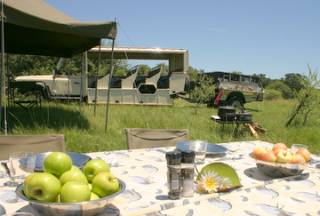
your meals will be prepared and waiting for you

The camping accommodations on this safari include spacious bow tents with camp beds, full bedding and includes luxurious camp showers and latrine facilities. This safari is a non participation safari, where camp chores are taken care of for you so you can spend your time in camp relaxing, sipping cocktails or freshening up. The large dome style tents are 10ft x 10ft in size, large enough to stand in and each tent has an en suite bush toilet and shower. The maximum number of guests per vehicle is 8 ensuring that everyone gets a window seat and your soft drinks, mineral water and alcohol are included.

Your tent, including your own private shower and toilet
.
Your spacious tent showing your sleeping accommodations
 
On this trip you will have the chance to observe
  • Lion
  • Leopard
  • Cheetah
  • African wild dog
  • Elephants, lots of them
  • Hippo
  • Zebra
  • Impala
  • Giraffe
  • Warthog
  • Hyena
  • Buffalo
  • Kudu
  • Hippos
  • Wildebeest
  • Crocodile
  • Chobe bushbuck
  • many other animals and to many birds to list

    Visit our website to read more about GrassTrack's newest safari and book your African trip today! 


    On our Fully Serviced Safari you will have the opportunity to take a relaxing Mokoro excursion on the Khwai River that originates from the Okavango Delta.


Tuesday, November 1, 2011

A Night Time Encounter with an Elephant

Traveling in Africa is a life changing experience. The exotic animals encountered, their shear numbers and wild antics and behaviors make every observation unique and exciting. But every now and again something really really incredible happens and if you're lucky enough that something just might happen when you're on safari. I have had a few such encounters on my trips to Africa and one of the most memorable happened during my last trip.

Traveling the wilds of Africa in daylight truly is amazing, but traveling at night takes one into a whole new realm of enchantment. Undertaking game drives at night is not a regular experience of most safari travelers. Predators are out and appropriate precautions are necessary, permits must be acquired and special expertise is needed. I have experienced only one night time game drive in Africa and that was way back in 2001. I've always wanted to do another night drive, but have never had the opportunity. Recently, while out on a day drive in Chobe National Park during a GrassTrack safari, we were experiencing animal sighting after animal sighting and lost track of time. Suddenly we were engulfed in darkness, miles away from camp and as we made our hurried way back we encountered a large elephant in the road, directly in front of us. Our guide killed our vehicle's engine and headlights and all of us wondered what in the H-E double L he was doing as we coasted to a stop within inches of the massive animal.

In the darkness of the African bush what's out their can see you, but you can't always see it

In the darkness, it was obvious that the elephant was confused. It reached its trunk out to us, swaying back and forth, appearing to access the situation for any signs of danger. Slowly she made her way around the front of our vehicle and as I peered through darkness to see the ghostly beast move past, I imagined I was experiencing something much like a boat passenger might feel as two massive ships pass at night on the open sea. It really was remarkable. We all strained to see the elephant as it moved along side us only inches away, while with every slow and methodical step, the elephant cautiously reassessed the situation before her. Within minutes the experience was over, she was gone, disappeared into the darkness, but in our emotional exhaustion everyone in the vehicle knew we had experienced something very special, something we would remember for the rest of our lives. It is surprising how such a simple encounter can hold so much meaning.

Isn't it time that you treated yourself to a GrassTrack's safari! Check out our website and book a trip today!
 

The bush silhouetted against the African night.

Monday, October 10, 2011

Chobe National Park - Day 2 More of the " Chobe Riverfront"


Our last African safari started in Maun, Botswana, traveled to the Moremi Game Reserve, the Savuti Marsh in Chobe National Park, and then to what is known as the Chobe Riverfront before finishing at Victoria Falls in Zambia, one of the Seven Wonders of the World. In this blog we have been reporting on this fabulous trip and today we recount our experience visiting the Chobe Riverfront.

After having spent one marvelous day in Chobe National Park, the fifth of our safari, our sixth day was spent in additional explorations along the magnificent Chobe Riverfront. The Riverfront lies along approximately 10 miles of the Chobe River near the town of Kasane in extreme northeastern Botswana, only 55 miles west of Victoria Falls. On the two maps below you can see the locations of Maun, Moremi, Chobe National Park within Botswana, and the location of the Riverfront within the Park.


The Riverfront is known for the large number of wildlife that migrate to the area during the dry season. In very dry years it is the only place where wildlife can find water to sustain themselves until the rejuvenating rains come again. The highlands of Angola receive copious amounts of rainfall during the rainy season and these rains are carried out of the mountains by the Cuando River, which becomes the Kwando, Linyanti, and finally the Chobe River before meeting the Zambezi river outside of Kasane at the Botswana-Zambia border. It is the last stretch of this great river, when it becomes the Chobe, where great herds of wildlife congregate.


A family of elephants make  way across the Chobe River along the Riverfront


Large herds of wildlife occur everywhere along the waterfront. Elephant and buffalo, especially, form into huge herds for which the park is famous. The number of elephant at the Chobe Riverfront is just mindboggling and there must have been 200 to 300 elephants on the Riverfront this day. Along with the huge herds of elephant, buffalo, and giraffe you can also expect to see tsessebe, waterbuck, roan, eland, sable, and giraffe (all of which we saw) and, if you are lucky, the rare puku, which we did see for a fleeting moment, but were unable to capture on film. The Puku is a rare antelope found in floodplain grasslands near water in south-central Africa.


Cape buffalo chew the cud along the Chobe Riverfront
Sable drink from a water hole along the Chobe River. These shy antelope are rarely ever seen.


The floodplain along the Riverfront makes an ideal viewing area with mixed patches of open grassland, thickets of bush, and riverine forest. In the river itself you will see hippo and crocodile and from the Namibian side of the river you may even see fishermen casting their nets into the Chobe while trying to avoid the resident crocodiles.


A hippo opens its mouth wide

Namibians fish the Chobe River.


Because of its abundant wildlife, the Riverfront is the Park's greatest attraction drawing thousands of visitors every year. This amazing place is one of the top ecotravel destinations in the world and because of the number of giraffe, zebra and antelope residing in the area lion, leopard, and chetah are a regular sight. The birdlife is also exceptional, from the larger species such as kori bustards, secretary birds and maribou storks, through to the brilliantly colored lilac-breasted rollers.  Fish eagles swoop overhead, dive bombing into the river to catch their daily diet of fish. Botswana and the Chobe Riverfront are a must see destination for every traveler so don't hesitate any longer, go to GrassTrack Safaris today and book your adventure safari to visit this magnificent place!


A crocodile suns itself along the banks of the Chobe River

A vulture peers over the Riverfront
A kori bustard on the floodplain


Storks at a pond on the Chobe Riverfront


I hope you enjoyed the article and don't forget to visit our website and book a trip to Africa to view this magnificent place

Sunset in the Chobe bush